
Last updated: December 2025
When you walk into a movie theater, you probably don’t think much about one simple question:
What exactly is the “screen” in front of you?
For most people, the answer feels obvious.
A movie theater means a projector and a projection screen.
But in recent years, more and more cinemas have started testing a different solution — Cinema LED Screens.
So the real questions are:
- What is a cinema LED screen?
- How is it different from traditional projection systems?
- And will movie theaters eventually switch to LED screens?
In this article, we’ll explain everything in a clear, simple, and easy-to-understand way, so anyone interested can get a clear picture.
What Screens Do Movie Theaters Use Today?
Let’s start with the basics.
What kind of screens do most movie theaters use today?
Traditional Cinemas: Projector + Projection Screen
This is still the most common setup in cinemas around the world.
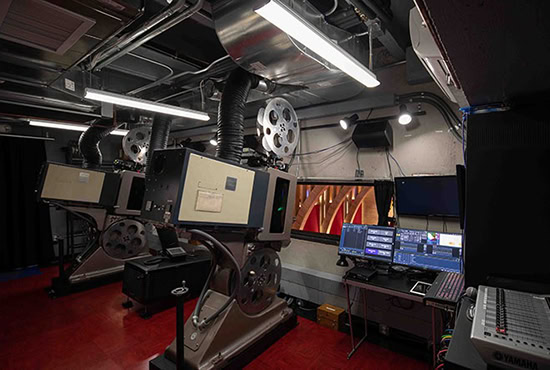
A traditional cinema usually includes:
- A digital projector (DLP or laser projector)
- A projection screen (high-gain or matte screen)
- A dark viewing environment
This system has been used for decades. It’s reliable, mature, and relatively cost-effective, which is why most commercial cinemas still rely on it.
Different Theaters Have Different Requirements
If you pay attention, you’ll notice that one cinema often has several types of auditoriums, such as:
- Standard halls
- Large format or giant screen halls
- VIP theaters
- High-end immersive cinemas
Most of them still use projectors.
However, their requirements for brightness, contrast, screen size, and audio-visual experience are not the same.
Because of these differences, cinemas started asking a new question:
Is there a display solution that can offer better brightness, higher contrast, and more stable image quality?
This is where cinema LED screens entered the picture.
What Is a Cinema LED Screen?
In simple terms:
A cinema LED screen is a large LED display that shows images directly, without using a projector.
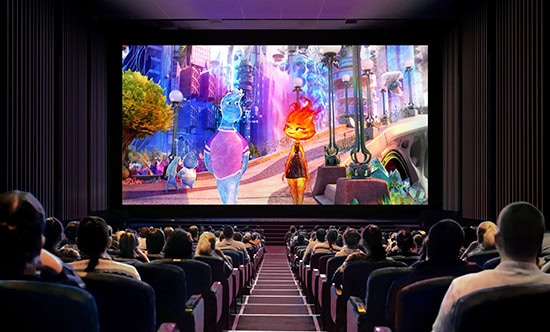
Technically, it is similar to the LED screens you see in shopping malls or outdoor advertising.
But for cinema use, the requirements are much higher:
- Higher resolution
- More accurate color and grayscale performance
- Compliance with cinema and DCI standards
So actually, a cinema LED screen is a self-emissive display, not a reflective system like traditional projection.
How Does a Cinema LED Screen Work?
The working principle is actually very straightforward.
A cinema LED screen is made up of millions of tiny LED pixels.
Each pixel can emit light independently.
This means:
- It does not rely on ambient light
- It does not need a projection distance
As a result, black looks truly black, brightness is higher, and contrast remains stable.
Simply put, the visual experience feels clearer and more immersive.
This is the key reason why LED technology can enter the cinema industry.
Cinema LED Screen vs Traditional Projector
We’ve talked about “better visual experience,” but what does that really mean?
Let’s compare them in detail.
Brightness Performance
With traditional projection systems, brightness gradually decreases as the light source ages. Over time, the image becomes dimmer.
Cinema LED screens, on the other hand, offer much more stable brightness.
Because they don’t rely on reflected light, the image looks clearer and more vivid.
This advantage becomes especially noticeable in high-end theaters and HDR content.

LED Cinema Screen vs. Conventional Projector-Brightness
Contrast and Black Levels
Contrast is a critical factor for movie viewing.
In projection systems, “black” is essentially dark gray, especially in scenes with strong light and shadow contrast.
LED screens achieve black by turning pixels off completely. It’s simple, but extremely effective.
In dark scenes, sci-fi movies, or thrillers, the difference is immediately visible.
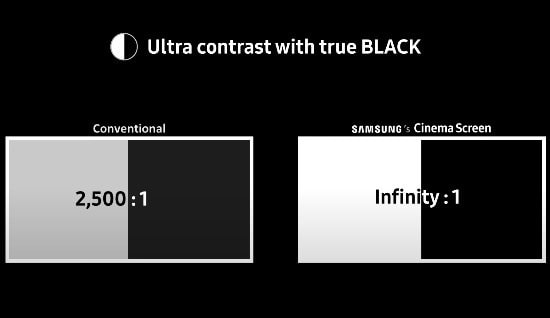
LED Cinema Screen vs. Conventional Projector-Contrast Ratio
Resolution and Image Detail
Resolution is another area where cinema LED screens stand out.
Most cinema LED displays support resolutions from Full HD to 4K, and some high-end projects have already reached 8K.
This means that even on very large screens, images remain sharp. Fine details stay visible, without blur or visible pixel grain.
In super-large cinema screens, resolution and pixel density are especially important. (You can learn more about the basic concepts of LED display resolution here.)
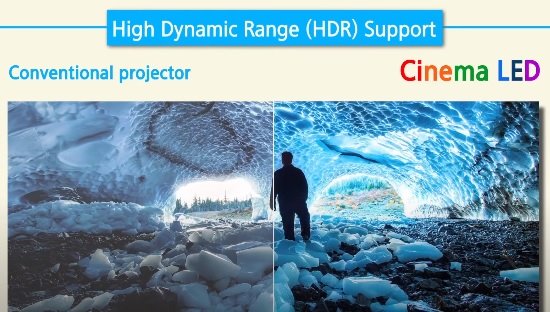
LED Cinema Screen vs. Conventional Projector-Resolution
Color Accuracy and Image Consistency
Projection systems are sensitive to many external factors.
Lamp aging, dust, and environmental changes can all affect image quality. Regular maintenance and recalibration are required to maintain consistency.
Cinema LED screens are easier to control in this regard. They are factory-calibrated, with high uniformity across the entire screen. Colors appear more vivid, saturated, and consistent over time.
Over long-term use, this stability becomes a real advantage. It helps cinemas deliver consistent image quality and reduces maintenance-related issues.
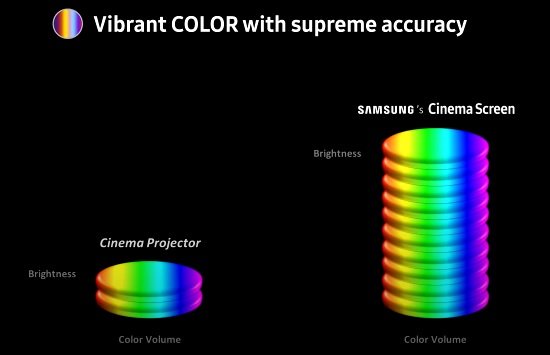
LED Cinema Screen vs. Conventional Projector-Color Accuracy
Space and Installation
Traditional projection systems require:
- A projection distance
- A projection room
- Ventilation and fire protection design
All of this takes up space and increases construction costs.
Cinema LED screens are installed directly on the wall, like a display system. They save space and can even support curved designs without image distortion.
This flexibility opens up new possibilities for creative theater layouts.
Pros & Cons of Cinema LED Screens
This leads to the most practical question:
If cinema LED screens are so good, why aren’t they everywhere?
The answer is simple.
Why Were LED Screens Rare in Cinemas Before?
In the past, the main challenges were:
- High cost
- High technical requirements
- Strict cinema standards
- Complex installation and integration
At that time, projection systems offered the best balance between performance and cost.
Why Is the Situation Changing Now?
In recent years, things have changed quickly.
- LED display technology has improved significantly
- 4K and even 8K resolutions are becoming more mature
- HDR content is more common
- LED lifespan and stability are much better than before
More importantly, cinemas are no longer focused only on, “Can we show movies?”
They are asking, “Can we offer a different and better experience?”
So here is a clear table of the pros and cons of cinema LED screen and Conventianl Projector to give you a clear view.
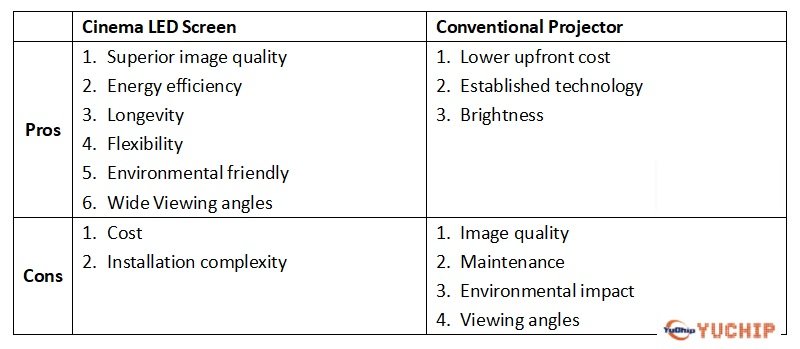
Advantages of Cinema LED Screens
- Higher brightness and contrast
- More realistic colors
- Not affected by ambient light
- Stable image quality over time
Limitations to Consider
- Higher initial investment
- Higher installation and design requirements
- Not suitable for every cinema
So, cinema LED screens are not a full replacement for projection, but a strong option for specific, high-end scenarios.
How Much Does a Cinema LED Screen Cost?
This is one of the most frequently asked questions.
First, it’s important to understand that there is no fixed price for a cinema LED screen.
The total cost depends on several factors:
- Screen size
- Resolution level (2K, 4K, or higher)
- Pixel pitch
- Installation structure and site conditions
- Maintenance and lifespan
Overall, the upfront cost of a cinema LED screen is usually higher than traditional projection.
However, when long-term performance, brightness stability, and maintenance are considered, the cost structure can look very different.
That’s why it’s more reasonable to compare long-term value, not just initial purchase price.
Will LED Screens Replace Projectors in the Future?
This question comes up all the time.
As Cinema LED screens continue to break through size limits, more and more cinemas are starting to seriously consider this option.
Some of the largest LED screen projects worldwide that have already been implemented have also proven, in real-world practice, that ultra-large LED displays are feasible.
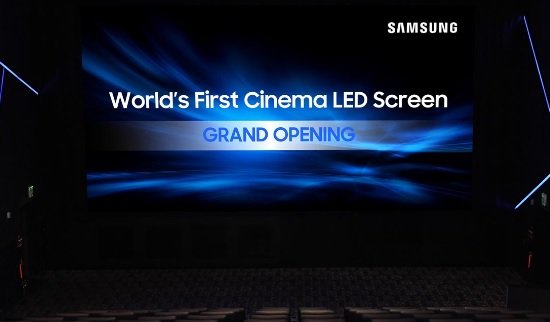
Giant LED Screen In Movie Theater
But the realistic answer is:
Not in the short term — but they will coexist.
Projection systems are still cost-effective and suitable for standard theaters.
Cinema LED screens are more often used as premium or upgrade solutions.
In the future, we’re likely to see:
- Projection in standard halls
- LED screens in high-end or special-format theaters
LED screens won’t replace everything, but they are becoming an important part of cinema display systems.
The Biggest Cinema LED Screens Already in Use
Many people still wonder:
Is this technology still just a concept?
The answer is no.
Large-scale, 4K-level cinema LED screens are already in real commercial use, especially in China and other international markets.
These projects clearly show that cinema LED screens are not laboratory concepts.
They are fully capable of supporting real movie screenings.
For example:
- At Capital Cinema in Beijing, a Samsung Onyx Cinema LED screenmeasuring about 14 meters wide was installed. It supports 4K HDR and is DCI-certified, delivering high brightness and contrast for a premium viewing experience.
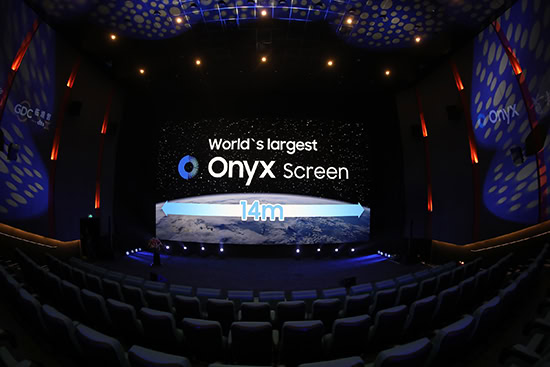
- Beyond China, Samsung Onyx cinema LED screens have also been installed in locations such as Los Angeles (USA)and Arena Cinemas in Zurich, Switzerland, showing a growing global adoption trend. (Source: Samsung Global Newsroom)
These real-world examples prove that cinema LED technology has entered the commercial stage.
If you’re interested in even larger LED display projects, you can also explore our article on Largest LED Screen in the World to see how far LED display technology has already gone.
FAQ: Common Questions About Cinema LED Screens
1.Why don’t most movie theaters use LED screens yet?
The main reasons are cost and renovation complexity. For standard theaters, projection is still the more economical choice.
2.Are cinema LED theaters more expensive to build?
Yes, the initial investment is usually higher, especially for the screen itself. However, long-term stability and maintenance can offer different value over time.
3.Will movie tickets be more expensive in LED theaters?
Not necessarily. Some cinemas position LED theaters as premium halls with higher ticket prices. Others use them mainly as a branding or experience upgrade, without significant price increases.
4.What types of theaters are best suited for LED screens?
Cinema LED screens are ideal for:
- High-end theaters
- Experience-focused theaters
- Flagship or showcase cinemas
- Venues with very high image quality requirements
Final Thoughts
Cinema LED screens are not about replacing everything. They represent an upgrade option for movie theaters. Projection systems are still good enough for everyday movie viewing. But for cinemas that want to offer a brighter, more immersive, and more distinctive experience, LED screens open up a new path.
So if you need any help or have any questions about cinema LED screens, just feel free to message us at manager@yuchip.com.