
Introduction
When it comes to cinema experiences, two names often come up: Giant Screen vs IMAX. But what really sets them apart? Is IMAX just a more advanced giant screen——or is it something entirely different? In this 2025 guide, we’ll explain their key features, differences, and best applications to help you decide which is worth your time and money.
What is a Giant Screen?
As the name suggests, a Giant Screen is usually huge. It can cover an entire wall to fill your entire field of view. These screens are usually used in commercial environments to make viewers have immersive movie experiences, events, and advertising. Unlike traditional movie screens, these displays are designed to offer a larger, more immersive viewing experience with clearer details.
When upgrading a cinema, many operators compare giant screens with IMAX to decide which format to choose, and moviegoers often also look at the full 3D vs IMAX comparison to understand which experience fits their needs.

What is a Giant Screen
Key Features: Giant Screen Technology
- Size: Giant screens are much larger than standard movie screens, ranging from 50 to 100 feet. This large size can help create an immersive experience for viewers.
- Aspect Ratio: These screens usually have a 16:9 aspect ratio, making them perfect for modern movies and video content.
- Technology: Giant Screens often use LED or DLP (Digital Light Processing) technology, which ensures vibrant brightness and clarity-though not as fine-tuned as IMAX’s projection systems.
What is IMAX?
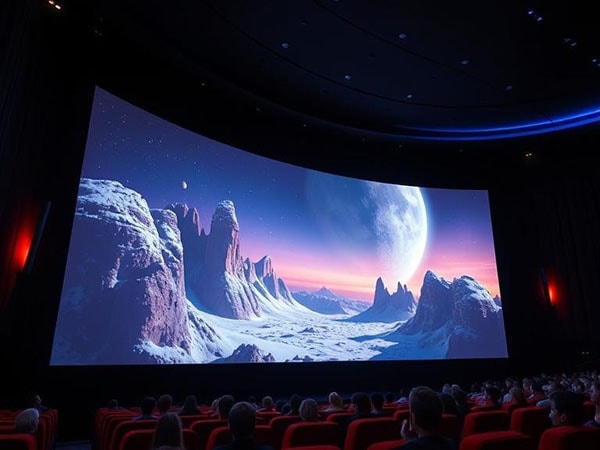
IMAX is short for Image Maximum. It is a premium movie technology owned by IMAX Corporation. Since the 1970s, IMAX has been famous for its towering screens and ultra-sharp clarity. But it’s more than just a big screen. IMAX uses specialized projectors, sound systems, and custom screen designs to deliver a next-level, immersive experience.
What is IMAX
Key Features: IMAX Explained
- Proprietary System: IMAX uses custom 4K or higher laser projectors and unique 1.43:1 or 1.90:1 aspect ratios for more detail and a more immersive visual effect.
- Curved Screens: To enhance the sense of immersion, most IMAX screens are curved to fill your peripheral vision.
- Advanced Audio: With a 12.1-channel sound system, IMAX offers precise and surround sound.
- High Production Standards: Many films are either specifically shot for IMAX or remake to ensure the top
Pros & Cons Comparison: Giant Screen vs IMAX
Giant Screen Pros
- Flexible Sizes: The large size of Giant Screens can offer an incredibly immersive experience, especially for large audiences.
- Wider Availability: Giant Screen cinemas are easier to find. There are over 5,000 Giant Screen cinemas worldwide.
- More Affordable Tickets: Giant Screen cinemas are usually 30-40% cheaper than IMAX.
- Suitable for Casual Viewers: They are ideal for family-friendly movies or films that aren’t visually heavy.
Giant Screen Cons
- Less Precision in Visuals: Giant Screens can offer stunning visuals, but they may not match IMAX in terms of color and contrast accuracy.
- Limited HDR Support: Many Giant Screens do not support High Dynamic Range (HDR) technology. This will affect contrast and color vibrancy.
- No Exclusive Content: Unlike IMAX, Giant Screens lack exclusive formats or enhancements.
IMAX Pros
- Unmatched Visual Quality: With high resolution, clarity, and stunning color depth image quality, IMAX is undoubtedly the top tier in the field.
- Immersive Experience: The combination of curved screens and advanced audio systems creates an immersive and lifelike experience for the viewers.
- Brighter Screens: IMAX screens are often brighter than traditional cinema screens. It can enhance clarity even in 3D films.
IMAX Cons
- Higher Costs: IMAX theaters are expensive to build and maintain. Tickets are also 40-50% more expensive than Giant Screen tickets. The expensive price limits some of the viewers.
- Limited Availability: IMAX has only around 1,500 theaters worldwide as of 2025, compared to over 5,000 Giant Screen venues. This makes access more limited, especially in smaller cities.
Giant Screen vs IMAX: Detailed Comparison
Screen Size & Shape
- Giant Screen: The Giant Screen is usually between 60-80 feet, with a 16:9 aspect ratio. These screens are large but usually maintain a flat rectangular shape. You can find them in commercial places or large event spaces.
- IMAX: IMAX can range from 72 to 100 feet wide, with a 1.43:1 aspect ratio. It can offer more vertical detail. IMAX screens are uniquely designed and often stretch across the theater. This curvature helps immerse the audience by filling their peripheral vision.

Giant Screen vs IMAX-Screen Size Comparison
Resolution & Brightness
- Giant Screen: These screens offer excellent HD or 4K resolution for large audiences. Their brightness can reach around 14-foot-lamberts (FL). While they provide clear visuals, the resolution is often more limited compared to IMAX.
- IMAX: IMAX has important advantages in resolution and brightness. It’s 12K laser projection and brightness of up to 22 FL can offer deeper contrast and vibrant colors. The screens are specifically designed for ultra-high-definition content, making them perfect for 3D films.
In real-world applications, the definition of a “giant screen” has expanded beyond IMAX. Some permanent LED installations now cover tens of thousands of square meters. A full list of the world’s largest LED screens can be found here.
Sound Systems
- Giant Screen: The sound quality is good but usually relies on standard surround sound technology like Dolby Atmos or 7.1 surround.
- IMAX: IMAX is famous for its custom sound systems, which can be specially optimized for each theater. With a 12.1-channel sound system, it offers precise audio positioning for an even more immersive experience.
Applications
- Giant Screen: The Giant Screen is ideal for general audiences, family movies, and budget-conscious viewers. What’s more, it’s great for museums, live events, billboards, and educational content. LED Giant Screens perform excellently in outdoor or commercial environments.
- IMAX: Dominates premium cinemas, especially for action films, sci-fi movies, and documentaries shot in IMAX format.
Giant Screen vs IMAX: Quick Comparison Table
| Feature | Giant Screen | IMAX |
| Size | 60-100+ ft, flexible | 72-100+ ft, standardized |
| Aspect Ratio | 16:9 | 1.43:1 |
| Shape | Flat or curved, customizable | Mostly curved, fixed |
| Resolution | Up to 8K (LED), varies | Up to 12K, consistent |
| Brightness | Varies, LED excels | High, laser-driven |
| Sound | Multichannel, varies | 12.1-channel, top-tier |
| Best For | Events, ads, education | Blockbusters, 3D films |
| Cost | More affordable | Premium pricing |
Best Use Cases: IMAX vs Giant Screen (By Movie Type & Audience)
- Action & Sci-Fi Films: IMAX wins with its high resolution, immersive sound, and 3D capabilities. It is perfect for movies like Avatar or Star Wars.
- Documentaries & Education: The sharp and ultra-high-definition visuals of IMAX are great for nature documentaries or educational content requiring vivid, detailed images.
- Live Events & Sports: Giant Screens, especially LED-based ones, are perfect for stadiums or outdoor broadcasts, attracting large crowds.
- Budget-Conscious Viewers: Giant Screens offer a great large-screen experience at a lower cost compared to IMAX tickets.
Final Thoughts (2025 Edition)
In a word, choosing between Giant Screen and IMAX depends on your needs and budget. On the one hand, IMAX can offer you the most immersive viewing experience with excellent visuals, sound, and details. But you have to pay more. On the other hand, the Giant Screen can provide a great viewing experience at a more affordable price. It’s suitable for most of the movies and viewers.
From entertainment to advertising, Giant Screens, especially LED-based ones, offer flexibility and value for a wide range of uses. At YUCHIP, we are proud to offer cutting-edge LED screens that bring the magic of giant screens to life, tailored to your vision. Whether you’re planning a cinema, event venue, or outdoor display, our custom LED giant screens are built to impress. Contact us today to bring your vision to life.
→Want to go beyond IMAX and explore how different 3D cinema technologies compare? Check out our full guide on 3D Cinema Technologies Comparison.
FAQ: Giant Screen vs IMAX in 2025
1.Where can I find giant screens or IMAX theaters near me?
Giant screens are more common, with over 5,000 locations worldwide, often in commercial venues or standard theaters. IMAX theaters are rarer (around 1,500 globally), so check IMAX’s official website or local cinema listings to find one near you.
2.Is IMAX really worth the extra cost in 2025?
It depends on what you value. If you’re after unmatched visuals, brighter screens, and immersive sound—especially for action-packed blockbusters or 3D films—IMAX is worth it. For a more affordable big-screen experience that’s still impressive, giant screens are a great choice. Still, if you’re watching a non-blockbuster film or want to save money, Giant Screens offer excellent value in most cases.
3.Are all IMAX theaters the same?
Not quite. True IMAX theaters use the full 1.43:1 aspect ratio and laser projectors, but some smaller “IMAX” venues (sometimes called “Lie-MAX” by fans) use a less immersive setup. Always check the theater specs for the best experience.
4.Can giant screens be used outside of movie theaters?
Yes! Giant screens, especially LED-based ones, are popular for outdoor events, sports broadcasts, advertising, and educational displays. Their flexibility makes them a go-to choice beyond just cinema.
5.Do I need special glasses for giant screen or IMAX movies?
It depends on the film. Both can show 3D movies requiring glasses, but for 2D screenings, no glasses are needed. IMAX’s brightness and clarity often make its 3D experience stand out more.
Related Articles You May Like:
Largest LED Screens in the World (2025): Top 25 Biggest Displays
3D vs IMAX: Which Is Better for Your Next Movie?
About Cinema LED Screen: All You Need To Know