
Introduction
When choosing between an LED mesh display and a traditional LED screen, the difference goes far beyond appearance.
In large outdoor projects, the real comparison is often between LED mesh displays and traditional outdoor LED screens. While both are used for building exteriors and large-scale installations, their structures and performance lead to very different results.
A traditional outdoor LED screen can deliver strong brightness and solid visuals, but it also adds significant weight and completely blocks what’s behind it. An LED mesh display, by contrast, is lightweight and transparent—making it a better fit for building facades, but not always for close viewing.
These differences directly affect how your project is designed, installed, and even whether it is structurally feasible.
In this guide, we’ll compare LED mesh displays and traditional LED screens to help you choose the right solution for your project.
If you’re new to this technology, you can first understand what an LED mesh display is.
What Is an LED Mesh Display?
An LED mesh display is a type of LED screen designed with a hollow, grid-like structure. Instead of a fully enclosed panel, it consists of LED strips or nodes arranged with gaps in between.

This design creates several important advantages.
First, it offers high transparency, typically ranging from 30% to 90%. This means the screen does not completely block light, airflow, or visibility behind it. That’s why it is widely used on glass buildings and media facades.
Second, it is extremely lightweight. Compared to traditional outdoor LED cabinets, mesh displays place much less load on building structures, making them ideal for large-scale installations.
Third, the flexible structure allows easier installation, especially on irregular surfaces or curved facades.
Because of these features, LED mesh displays are commonly used in:
- Building facades
- Shopping mall exteriors
- Large architectural media projects
For example, lightweight mesh solutions like the BD Series LED Mesh Display are often used where structural load is limited, while high-transparency options like the BG Series LED Grille Screen are better for glass curtain walls.
What Is a Traditional Outdoor LED Screen?
A traditional outdoor LED screen uses solid LED panels (also called cabinets) that are tightly assembled together to form a continuous display surface.
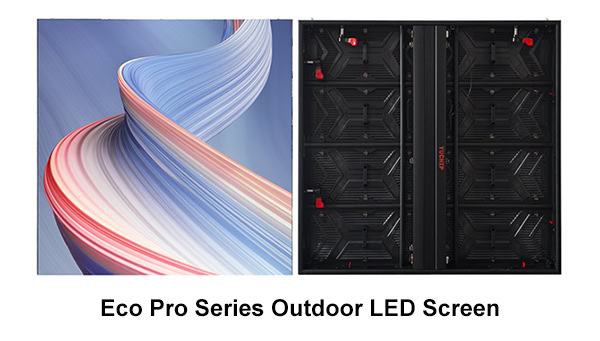
Unlike mesh displays, there are no gaps between pixels. This allows for higher brightness and relatively good image clarity, even in outdoor environments with strong ambient light.
Traditional outdoor LED screens are designed to deliver:
- High brightness for sunlight visibility
- Durable, weather-resistant structures
- Continuous and solid display surfaces
Because of this, they are commonly used in:
- Outdoor advertising billboards
- Stadium screens
- Building-mounted LED displays
- Large public information screens
In short, traditional outdoor LED screens are built for brightness and visual impact, while mesh displays are designed for structural efficiency and architectural integration.
LED Mesh Display vs Traditional LED Screen: Key Differences
To better understand how these two technologies differ in real-world outdoor applications, it helps to look at their core features side by side.
The table below highlights the key differences between LED mesh displays and traditional outdoor LED screens, making it easier to compare their structure, performance, and ideal use cases.
Quick Comparison
| Feature | LED Mesh Display | Traditional LED Screen |
| Structure | Grid / hollow | Solid panel |
| Transparency | High | None |
| Weight | Very light | Heavy |
| Wind Resistance | Strong | Lower |
| Installation | Flexible | Fixed |
| Viewing Distance | Long distance | Medium to long |
| Best Use | Building facade | Outdoor ads, billboards |
Transparency and Visual Impact
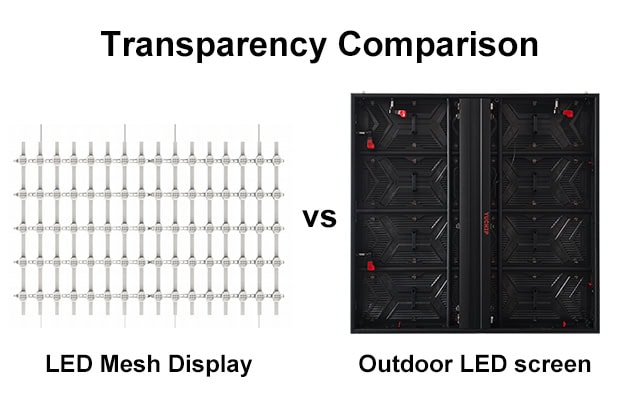
One of the biggest differences is transparency.
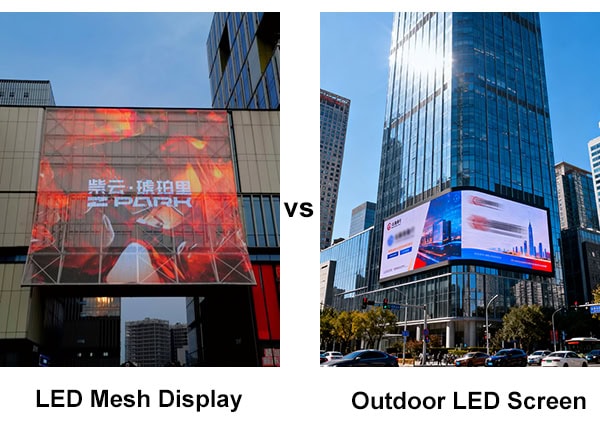
LED mesh displays allow light and air to pass through the screen. This makes them ideal for glass buildings or architectural facades where maintaining visibility and natural lighting is important.
In contrast, traditional outdoor LED screens are completely opaque. Once installed, they fully cover the building surface behind them.
If your project involves a modern glass facade or requires visual integration with architecture, mesh displays are clearly the better choice.
Weight and Installation Complexity
Weight plays a major role in large outdoor LED projects.
Mesh displays are significantly lighter because of their open structure. This reduces the need for heavy steel support systems and lowers installation complexity.
Traditional outdoor LED screens, on the other hand, are much heavier. They often require reinforced structures, especially when installed on building exteriors.
For projects where structural load is a concern—such as high-rise buildings—lightweight mesh displays are often the only practical option.
Wind Resistance and Outdoor Performance
For outdoor installations, wind resistance is critical.
Because of their open design, LED mesh displays allow wind to pass through. This greatly reduces wind load and makes them safer for large-scale outdoor use.
Traditional outdoor LED screens act like a solid wall. In high-wind environments, this can create significant pressure on the structure, increasing both engineering complexity and cost.
This is one of the key reasons why mesh displays are widely used in media facade projects.
Resolution and Viewing Distance
This is where traditional LED screens still have an advantage.
Because they use a solid surface with more concentrated pixels, they can deliver better image clarity compared to mesh displays, especially when content needs to be more visually defined.
However, in most outdoor scenarios where viewing distances are long, ultra-high resolution is less critical. LED mesh displays are designed for this type of environment.
If your audience will be relatively close to the screen, a traditional LED display may still be the better option.
Application Scenarios
The differences in structure and performance lead to different use cases.
LED mesh displays are best for:
- Building facades
- Large outdoor media walls
- Landmark architecture
- Projects requiring transparency
In large architectural projects, solutions like media facade systems such as the BM Series Media Facade LED Display are specifically designed to turn entire buildings into dynamic digital displays.
Traditional outdoor LED screens are best for:
- Outdoor advertising billboards
- Stadium displays
- Public information screens
- Building-mounted solid displays
Choosing the wrong type can lead to unnecessary costs or structural challenges, so it’s important to match the display to the application.
When Should You Choose an LED Mesh Display?
An LED mesh display is not just an alternative—it is often the more practical solution for large-scale outdoor architectural projects.
This is especially true when structural limitations, environmental conditions, or building design make solid LED panels difficult to install. Thanks to its lightweight and transparent structure, a mesh display solves problems that traditional outdoor screens cannot.
You should consider an LED mesh display if your project involves:
- Large-scale building facades where solid screens would be too heavy
- Glass curtain walls that require natural light and visibility
- Outdoor locations with strong wind conditions
- Projects with strict limits on structural load
- Installations that require flexible or custom shapes
In these scenarios, mesh displays reduce structural stress, simplify installation, and often lower total project cost.
When Is a Traditional LED Screen a Better Choice?
A traditional outdoor LED screen becomes the better choice when brightness and visual clarity are more important than structural flexibility.
Solid LED panels are designed to deliver consistent image performance in outdoor environments, especially where visibility under strong sunlight is required.
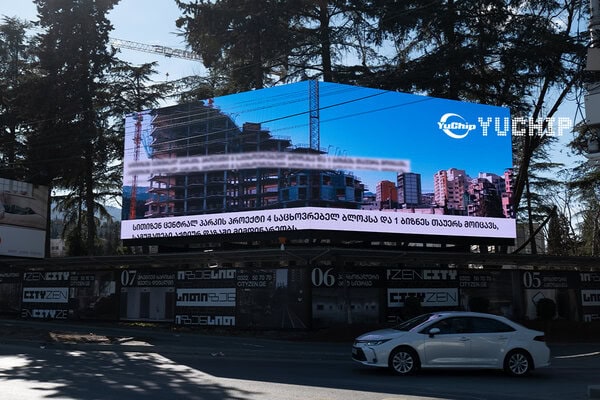
In general, a traditional LED screen is the right option for:
- Outdoor advertising billboards
- Stadium and large event displays
- Applications requiring strong brightness and visibility
- Projects where transparency is not needed
For example, roadside billboards or stadium screens rely heavily on brightness and solid visuals. In these scenarios, traditional LED screens provide more direct visual impact.
Cost Comparison: Mesh vs Traditional LED Display
Many people assume that LED mesh displays are more expensive, but that’s not always true.
The total cost of an LED display project depends on several factors, including:
- Pixel pitch
- Screen size
- Installation complexity
- Structural requirements
While the unit price of a mesh display can be higher in some cases, the overall project cost may actually be lower.
This is because mesh displays require:
- Less steel structure
- Simpler installation
- Easier transportation
In large outdoor projects, structural cost often becomes a major part of the budget. For example, installing a large traditional outdoor LED screen on a building facade may require a heavy steel framework to support its weight and resist wind load. This can significantly increase both material and installation costs.
By comparison, an LED mesh display can cover a larger area with much lower weight and wind resistance. In some cases, this allows the project to reduce structural costs enough to offset the higher unit price of the display itself.
As a result, for large-scale facade applications, LED mesh displays are often more cost-efficient than traditional outdoor LED screens.
Which One Is Right for Your Project?
Choosing between an LED mesh display and a traditional LED screen comes down to your specific application.
If your project is a large outdoor facade—especially on a glass building—an LED mesh display is usually the better choice. It offers better structural efficiency, lower wind load, and improved architectural integration.
If your project focuses on outdoor advertising, brightness, and direct visual impact, a traditional LED screen will deliver more consistent results.
In many cases, the decision is not about which technology is better—but which one fits your project requirements.
If you’re planning a project and are unsure which solution fits best, exploring different LED mesh display options or consulting with a supplier can help you make a more informed decision.
FAQs
1.Is an LED mesh display better than a traditional LED screen?
It depends on the application. Mesh displays are better for building facades and large outdoor structures, while traditional outdoor LED screens are better for advertising and high-visibility displays.
2.Can LED mesh displays show high-quality images?
Yes, but they are optimized for long-distance viewing. Traditional LED screens offer better clarity for more detailed visuals.
3.Are LED mesh displays suitable for outdoor use?
Yes, they are specifically designed for outdoor environments, especially for large architectural installations.
4.Are LED mesh displays expensive?
Not necessarily. While product costs vary, overall project costs can be lower due to reduced structural and installation requirements.
5.How long do LED mesh displays last?
With proper maintenance, both mesh and traditional LED displays can last 5–10 years or more, depending on usage and environment.