
Introduction
When comparing Mini LED vs IPS, the key question most users ask is simple: which one delivers better contrast, brightness, and real-world performance? While both technologies are widely used in modern displays, they serve different roles and are often misunderstood.
Mini LED is a backlight technology that improves local dimming and HDR performance, whereas IPS (In-Plane Switching) is a panel technology known for wide viewing angles and accurate color reproduction. In fact, many premium monitors combine IPS panels with Mini LED backlighting to achieve both strengths.
In this article, we’ll clearly explain how these technologies differ, compare them side by side, and help you decide which option is better for gaming, professional work, or commercial display applications.
Is Mini LED Better Than IPS?
The answer depends on what you need.
Mini LED is better for HDR, contrast, and high brightness applications, especially in premium TVs and professional displays.
IPS is better for wide viewing angles, consistent color accuracy, and cost efficiency, making it ideal for office monitors and competitive gaming displays.
If you want the best overall image quality with deep blacks, Mini LED has the advantage. If you prioritize affordability and balanced performance, IPS is often the smarter choice.
Mini LED vs IPS: Quick Comparison
| Best For | Mini LED | IPS |
| HDR & Contrast | ★★★★★ Excellent | ★★★☆☆ Moderate |
| Brightness | Very High (1000+ nits) | Moderate (300–600 nits) |
| Color Accuracy | Excellent | Excellent |
| Gaming Performance | Strong (with proper panel) | Very Strong (Fast IPS) |
| Professional Work | High-end HDR editing | Design & color work |
| Budget Friendly | No | Yes |
What Is Mini LED Technology?
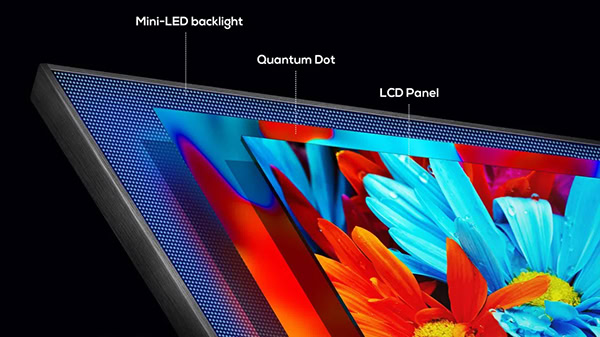
Mini LED is a backlight system that uses thousands of tiny LEDs behind an LCD panel. This creates more dimming zones, better brightness, and improved HDR compared to standard LED backlights. In real-world products, this usually means hundreds to thousands of local dimming zones, depending on screen size and model.
- Pros: High brightness (1,000–2,000 nits), strong contrast with local dimming, great HDR, long lifespan.
- Cons: Higher cost, risk of blooming, performance depends on the LCD panel.
- Common uses: Premium TVs, gaming monitors, iPad Pro, and pro displays.
What Is IPS Display Technology?
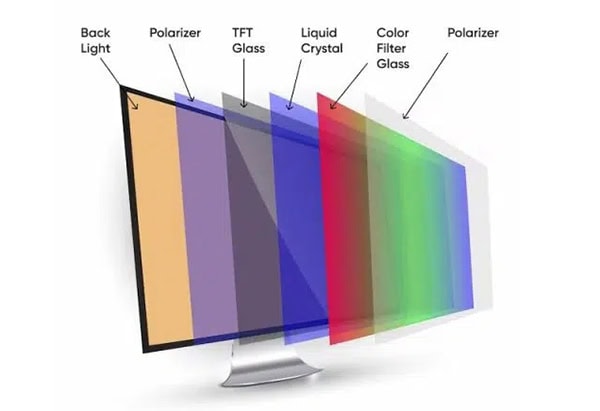
IPS (In-Plane Switching) is a type of LCD panel known for color accuracy and wide viewing angles. It improves on older TN panels by keeping colors consistent even when viewed from the side.
- Pros: Accurate colors (often 100% sRGB, up to 95% DCI-P3), wide viewing angles (178°), fast response on modern “Fast IPS,” great for creative work.
- Cons: Lower contrast than Mini LED or OLED, average brightness (250–400 nits), possible backlight bleed. In practice, most standard IPS panels still struggle to exceed a native contrast ratio of around 1,000:1 without advanced backlighting.
- Common uses: Monitors, laptops, smartphones, and TVs.
Mini LED vs IPS: Key Differences
Mini LED and IPS are not direct competitors but complementary technologies. Mini LED enhances LCDs with advanced backlighting, while IPS defines how the LCD panel displays images. Still, when comparing displays, buyers often ask: Should I choose a Mini LED or an IPS monitor/TV? Let’s break down the details.
Display Technology
- Mini LED: Upgraded LCD with thousands of tiny LEDs for localized dimming.
- IPS: A panel type under LCD technology, known for wide angles and stable colors.
In short: Mini LED improves the backlight, IPS improves the panel.
Contrast Ratio and Black Levels (IPS Black vs Mini LED)
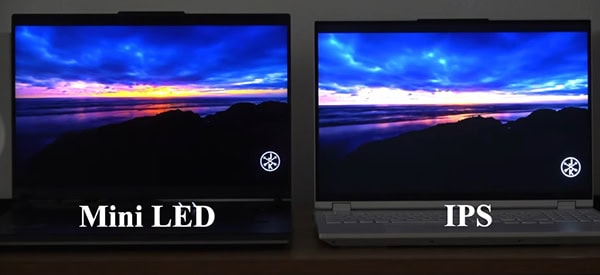
- Mini LED: Achieves high contrast with local dimming (up to 1,000,000:1). Blacks are much deeper than standard IPS.
- IPS: Standard IPS has weaker contrast (~1,000:1), but newer IPS Blackpanels double that (~2,000:1).
Bottom line: Mini LED wins overall in contrast and black levels, while IPS Black narrows the gap for bright-room or productivity use. For watching movies in dark rooms or editing videos with high contrast, Mini LED outperforms IPS.
Brightness
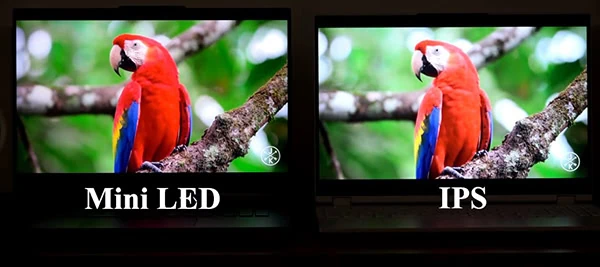
- Mini LED: Can hit 1,000–2,000 nits or more. Ideal for HDR and bright environments.
- IPS: Typically limited to 300–600 nits. High-end IPS monitors may reach ~1,000 nits.
Mini LED is far superior for HDR and daylight viewing. This difference becomes especially noticeable in HDR content and sunlit rooms.
Color Accuracy and Viewing Angles
- Mini LED: Depends on the LCD panel type (VA or IPS). When paired with IPS, it offers wide angles and strong accuracy.
- IPS: Excellent at maintaining color consistency from almost any angle.
IPS panels are unmatched for wide viewing; Mini LED only matches this if built on IPS panels.
Response Time and Gaming Performance (Fast IPS vs Mini LED)
- Mini LED: Response depends on panel type—IPS Mini LED monitors often have 1–5 ms response times, with refresh rates up to 240Hz.
- IPS: “Fast IPS” panels rival TN with ~1 ms response time and 240–360Hz refresh rates.
For competitive gaming, Fast IPS has an edge, but Mini LED IPS monitors combine speed with HDR brilliance.
Power Efficiency
- Mini LED: More efficient than older LCD backlights but still loses light through the LCD layer.
- IPS: Efficiency varies, but without Mini LED, brightness levels are usually lower.
Mini LED is brighter but consumes more power at peak output.
Cost and Availability
- Mini LED: Costs more due to complex backlight arrays. Premium laptops, iPads, and monitors use it.
- IPS: Widely available and affordable across all price ranges.
IPS is budget-friendly; Mini LED is positioned as a premium upgrade.
Current Applications
- Mini LED: High-end TVs, gaming monitors, iPad Pro, MacBook Pro, and indoor LED walls.
- IPS: Mainstream monitors, laptops, office displays, budget TVs.
Mini LED is more niche and premium; IPS dominates the mainstream market.
Summary Table: Mini LED vs IPS
| Feature | Mini LED | IPS |
| Technology | LCD with Mini LED backlight | LCD panel type (In-Plane Switching) |
| Contrast Ratio | Up to 1,000,000:1 with local dimming | ~1,000:1 (up to 2,000:1 with IPS Black) |
| Black Level | Deep blacks (near OLED level) | Moderate blacks (improved in IPS Black) |
| Brightness | 1,000–2,000 nits+ | 300–600 nits (higher in premium models) |
| Color Accuracy | Excellent with Quantum Dot + IPS | Excellent, wide viewing angles |
| Response Time | 1–5 ms (depends on panel type) | ~1 ms (Fast IPS) |
| Refresh Rate | Up to 240Hz | Up to 360Hz (Fast IPS) |
| Power Use | Higher at max brightness | Lower overall |
| Cost | Premium pricing | More affordable, mass-market |
| Applications | TVs, pro monitors, laptops | Monitors, laptops, office displays |
IPS LCD vs Mini LED – Clearing the Confusion
Searchers often type IPS LCD vs Mini LED, which creates confusion. Here’s the clarification:
- IPS is a type of LCD panel.
- Mini LED is a backlight technology used in LCDs (including IPS).
This is why many search results appear confusing—because they compare two different layers of the same display system.
So, technically, the right comparison is IPS LCD with Mini LED backlight vs IPS LCD with standard LED backlight. The Mini LED version is brighter, has better contrast, and costs more.
Buyer’s Guide: Which One Is Right for You?
If you’re still unsure whether Mini LED or IPS suits you, here’s a quick breakdown based on different needs:
(The video below offers a quick visual explanation of how Mini LED and IPS differ in real-world use.)
- Gamers: Choose Fast IPS if you care about speed and competitive play. Choose Mini LED (with IPS if possible) if HDR and immersion matter more.
- Designers & Editors: IPS is reliable for color work, but IPS + Mini LED is the best choice for HDR video and professional projects.
- Movie Lovers: Mini LED TVs deliver high brightness, deeper blacks, and a more cinematic experience.
- Everyday Office Work: IPS monitors are affordable, energy-efficient, and good enough for productivity tasks.
In short: IPS gives you great value and accuracy, while Mini LED delivers a premium HDR experience. If you can get both in one device, that’s the ideal solution.
IPS vs Mini LED vs OLED: Where Do They Fit?
Some buyers also compare IPS, Mini LED, and OLED. Here’s a quick comparison table to help you see their differences clearly:
| Technology | Strengths | Weaknesses | Best For |
| IPS LCD | Affordable, reliable, wide viewing angles, accurate colors | Weaker blacks, limited contrast | Budget-friendly displays, office monitors, casual gaming |
| Mini LED LCD | Very bright, high contrast, better HDR performance | Pricier than standard LCD, still not perfect blacks | HDR content, premium monitors, TVs, pro work |
| OLED | Perfect blacks, infinite contrast, vibrant colors, thin design | Risk of burn-in, higher cost, less bright in sunlight | High-end TVs, creative professionals, cinephiles |
Key takeaway: If you want balance, IPS + Mini LED combo is a sweet spot.
Conclusion
There is no single “best” technology—only the best choice for how you use your display. Mini LED and IPS are often compared, but they serve different roles in display technology. IPS ensures color accuracy and viewing angles, while Mini LED enhances contrast, brightness, and HDR performance. For everyday use and affordability, IPS remains a strong choice. For high-end visuals, Mini LED—especially when paired with IPS—delivers a premium experience.
If you’re shopping for your next display, consider how you’ll use it: gaming, design, movies, or office work. That will help you choose the right technology for your needs.
Looking for a professional LED solution? At YUCHIP, we provide advanced LED display technologies that fit every application. Contact us today to find the right display for your needs.
Last updated: December 2025
FAQ
1.Is Mini LED better than IPS?
Not directly. Mini LED is a backlight; IPS is a panel. They can work together.
2.Can Mini LED and IPS be used together?
Yes. Many high-end displays are IPS with Mini LED backlight.
3.Which is better for gaming: Mini LED or IPS?
Fast IPS for eSports; Mini LED for immersive HDR gaming.
4.Which lasts longer?
Both are reliable, but Mini LED tends to handle brightness aging better.
5.IPS vs Mini LED vs OLED – which should I choose?
IPS = affordable, accurate. Mini LED = bright, high contrast. OLED = best blacks, but expensive.
Related Articles You May Like:
IPS vs LCD: What’s the Difference & Which Should You Choose?
OLED vs IPS: Which Display Technology Should You Choose?
IPS vs LED: Key Differences, Advantages & Future Trends