
Introduction
Mini LED vs Micro LED has become one of the hottest topics in today’s display technology discussions. These two advanced LED display technologies offer major improvements in brightness, contrast, and picture quality compared to traditional LCDs. But what exactly is the difference between Mini LED and Micro LED? And which one is better for your next LED display project?
Mini LED vs Micro LED: What Is Mini LED Display Technology?
Mini LED is an advanced form of backlight technology used in LCD displays. It uses thousands of tiny LEDs—much smaller than traditional LEDs—to provide more precise local dimming and higher brightness.
Unlike Micro LED, Mini LED is not a self-emitting display. It still requires an LCD panel to create images, but the smaller LED backlights allow for better contrast and deeper blacks.
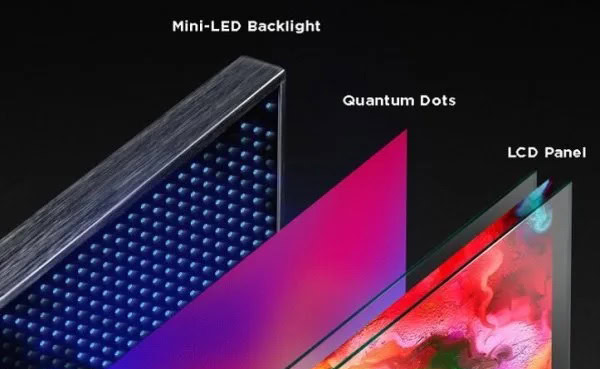
Key Features of Mini LED
- Uses miniaturized LEDs for backlighting
- Improves contrast, color accuracy, and brightness
- More energy-efficient than traditional LCD
- More affordable than OLED or Micro LED
Mini LED technology has already been used in TVs, monitors, laptops, and tablets, making it a mature and practical solution for many display applications.
Mini LED vs Micro LED: What Is Micro LED Display Technology?
Micro LED is a next-generation display technology where each pixel is made of a microscopic LED that emits its own light. It doesn’t need a backlight or color filter, which allows for pure blacks, ultra-high brightness, and incredible contrast.
This technology is often seen as the future of displays, combining the best qualities of OLED and LED without their limitations.
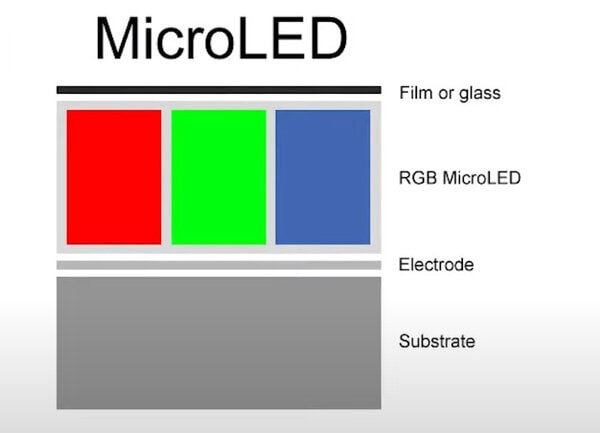
Key Features of Micro LED
- Self-emissive: each pixel lights up individually
- Infinite contrast ratio with true blacks
- Higher brightness and longer lifespan than OLED
- Resistant to burn-in
Due to the stunning performance of Micro LED display technology, they are ideal for high-end applications like luxury TVs, AR/VR headsets, and large commercial video walls. However, the high production costs and technical complexity make it still in the early stages of commercialization.
Mini LED vs Micro LED: Key Differences
Mini LED and Micro LED may sound alike, but they use very different technologies and offer different performance. Let’s see the key differences.
Display Technology
- Mini LED is not a self-emissive display.It’s an upgraded backlight system for LCDs. Thousands of tiny LEDs are placed behind the LCD panel to improve contrast and local dimming.
- Micro LED is a self-emissive display.Each pixel is its own LED light source. It works like OLED but with better brightness and longer life.
In short:
Mini LED still uses an LCD layer, while Micro LED is a next-generation display with no backlight or liquid crystals.
Contrast Ratio and Black Level
- Mini LED has much better contrast than regular LCDs.That’s because it has more and smaller backlight zones—some TVs have up to 2,000. This helps show deeper black.
- Micro LED has perfect black levels and infinite contrast.Each pixel can turn off completely, just like OLED—but with no risk of burn-in.
Example:
Mini LED TVs can reach contrast ratios around 1,000,000:1. Micro LED can go even higher, with true black—great for HDR content.
Brightness
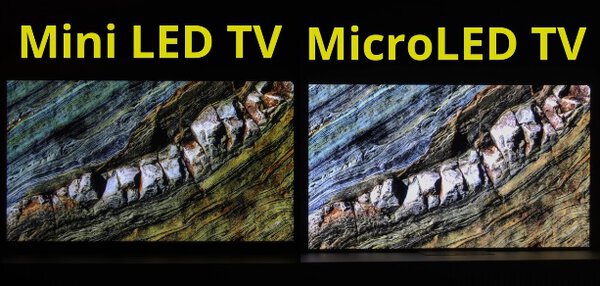
- Mini LED can hit brightness levels of 1,000–2,000 nits, depending on panel quality and the number of zones.
- Micro LED can go much brighter—over 5,000 or even 10,000 nits. This makes it perfect for outdoor use or bright rooms.
Bottom line:
Micro LED wins when it comes to extreme brightness, especially in commercial displays.
Mini LED vs Micro LED-Power Efficiency
- Mini LED is more efficient than traditionalLCDs, but it still loses some light through the LCD panel.
- Micro LED is very efficient because it doesn’t need a backlight or filters.It only uses power where light is needed.
In numbers:
Micro LED can be up to 50% more efficient than OLED and much better than Mini LED LCDs.
Response Time and Refresh Rate
- Mini LEDdepends on LCD panels, which typically have 5–10 ms response times and standard refresh rates up to 144Hz (240Hz in high-end models).
- Micro LED offers microsecond-level response times and supports extremely high refresh rates, even up to 240Hz or more, making it perfect for fast-action content.
Lifespan and Burn-in Risk
- Mini LED has a long life and no burn-in issuesbecause it uses LCD.
- Micro LED lasts even longer—over 100,000 hours—and has no burn-in risk, unlike OLED.
Thickness and Flexibility
- Mini LED panels are thinner than traditional LCDsbut still include several layers (LED backlight + LCD + polarizers).
- Micro LED displays are extremely thin and can be modular or flexible, allowing for custom shapes and curved screens.
Applications:
Micro LED is better suited for video walls, curved commercial displays, and wearables.
Color Performance

- Mini LED offers excellent color accuracy, especially when paired with Quantum Dots (QLED). But it’s still limited by the LCD layer.
- Micro LEDcreates color using tiny red, green, and blue LEDs. It offers a wider color range and more accurate colors.
Tech tip:
Micro LED can cover over 100% of the DCI-P3 color space—better than OLED in some cases.
Cost and Manufacturing Complexity
- Mini LEDis in mass production and has become more affordable. It costs more than regular LCDs but much less than OLED or Micro LED.
- Micro LED is still expensivebecause making it is complex. It’s hard to handle the tiny LEDs and keep yields high.
Example:
A Micro LED TV (e.g., Samsung The Wall) can cost over $100,000 USD, while Mini LED TVs are available for $1,000–3,000 USD.
Current Applications
Mini LED is widely used in:
- Consumer TVs and monitors
- Gaming laptops and tablets (e.g., iPad Pro)
- Some indoor LED displays
Micro LED is currently used in:
- High-end digital signage
- Outdoor displays with high brightness
- Prototype TVs and AR/VR systems
Summary Table: Mini LED vs Micro LED
| Feature | Mini LED | Micro LED |
| Technology Type | LCD with Mini LED backlight | Self-emissive display (no LCD needed) |
| Contrast Ratio | High (up to 1,000,000:1) | Infinite |
| Black Level | Deep blacks with local dimming | Perfect black |
| Brightness | 1,000–2,000 nits | 5,000–10,000+ nits |
| Color Performance | Excellent with QD-LCD | Wide color gamut (100%+ DCI-P3) |
| Power Efficiency | Good | Excellent |
| Response Time | 5–10 ms | Microseconds |
| Burn-in Risk | No | No |
| Lifespan | 50,000–70,000 hours | 100,000+ hours |
| Cost | Medium | Very High |
| Use Cases | TVs, monitors, indoor LED | Outdoor displays, luxury video walls |
| Market Status | Commercially mature | Still developing |
Mini LED vs Micro LED: Which One Is Better for LED Display Applications?
The answer depends on your application, budget, and display requirements.
- Choose Mini LED ifyou want a high-performance display at a more affordable price. It’s great for TVs, monitors, laptops, and most indoor LED display setups.
- Choose Micro LED ifyou need the best possible image quality, true blacks, and high brightness for premium video walls, outdoor signage, or virtual production. It’s ideal for large or high-end commercial displays.
If you’re building a standard LED screen for advertising, stage rental, or conference use, Mini LED usually offers the best balance of quality and cost. But if you’re after cutting-edge performance and budget is not a concern, Micro LED is the future-proof option.
Mini LED vs Micro LED: Market Trends and Future Outlook
- Mini LED is becoming more and more popular in consumer electronics. Big brands like Apple, Samsung, and ASUS have already launched Mini LED products. Over the next 3-5 years, Mini LED is expected to stay a strong competitor to OLED.
- Micro LED is not yet common, but it’s seen as the most exciting display technology for the future. As manufacturing improves, prices should come down, and more people and businesses will start using it.
Industry experts predict that Micro LED could start entering the mainstream market around 2026 or later, once production challenges are solved.
Conclusion
When comparing Mini LED vs Micro LED, the best choice depends on your needs and budget. Mini LED displays offer a big improvement over traditional LCDs with better brightness and contrast, while Micro LED displays deliver the best performance available today, but at a higher cost.
So when choosing between them, consider your display needs, budget, and the application. For most people right now, Mini LED is the practical choice. But if you’re preparing for the future and need the best of the best, Micro LED is worth considering. Still don’t know which to choose? You can contact YUCHIP expert team anytime!
FAQ
1.Is Micro LED better than Mini LED?
Yes, in terms of picture quality, Micro LED offers better contrast, brightness, and efficiency. But it’s also much more expensive and harder to produce.
2.Are Mini LED displays good for gaming?
Absolutely. Mini LED provides high brightness, fast response, and excellent contrast, making it ideal for gaming monitors and laptops.
3.Can Micro LED replace OLED?
In the long run, yes. Micro LED has the potential to outperform OLED without the risk of burn-in and with a longer lifespan.
4.Which is cheaper: Mini LED or Micro LED?
Mini LED is currently much cheaper and widely available, while Micro LED remains a premium option.
5.When will Micro LED become mainstream?
Industry experts predict Micro LED may reach mass adoption around 2026 or later as production costs decrease.
Related Articles You May Like:
LCD, LED, Or OLED: Which is Best for You?
Mini LED Vs OLED: Which Is Better In 2024?
What Are The Major Advantages Of Micro LED Screens?
What’s The Science Behind OLED’s Eye-Popping Color Accuracy?