
Introduction
Mini LED and QLED are two display technologies that often confuse buyers—and for good reason. Their names sound similar, they’re both marketed as premium upgrades, and many TVs even combine the two. But in real-world use, they solve very different problems.
The key difference isn’t brand or price—it’s how they handle light. One focuses on precise backlight control for deeper blacks and better contrast, while the other boosts brightness and color impact for vivid visuals in bright spaces.
If you’re choosing a TV, monitor, or commercial display, this distinction matters more than you might think. In this guide, we break down how Mini LED and QLED actually perform in movies, gaming, bright rooms, and professional environments—so you can decide which one truly fits your viewing needs—and more importantly, which one is actually better for your specific usage.
Quick answer:
- Mini LED is better for contrast, HDR, and dark-room viewing
- QLED is better for brightness, color, and bright environments
- Many premium TVs actually combine both technologies
Watch this quick comparison to understand how Mini LED and QLED differ in real-world picture quality:
What Is Mini LED?
Mini LED is a next-generation backlighting technology that uses thousands of ultra-small LEDs—each less than 0.2 mm wide. Compared to traditional LED backlights, it provides significantly more local dimming zones, sometimes exceeding 1,000 to 2,500+ local dimming zones in high-end models, for better brightness control and contrast. This higher zone density allows the display to control light much more precisely, especially in HDR scenes with bright highlights and dark backgrounds.
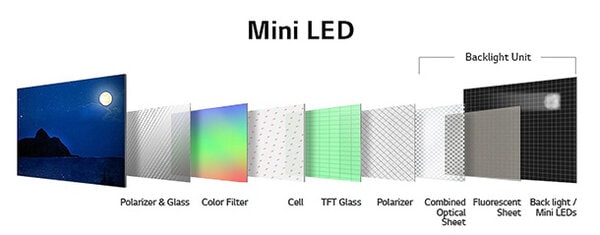
It still uses an LCD panel, but thanks to its precision lighting, Mini LED can deliver deep blacks and punchy highlights, making it ideal for HDR content, gaming, and professional work. You’ll find this tech in premium displays like Apple’s iPad Pro and Samsung’s Neo QLED TVs.
What Is QLED?
QLED (Quantum Dot LED) is an LCD-based display technology that enhances color using a layer of quantum dots. These microscopic particles boost color brightness and accuracy when lit by a standard LED backlight. Unlike OLED or Mini LED, QLED does not change how the backlight is controlled—it focuses purely on improving color performance and brightness efficiency.
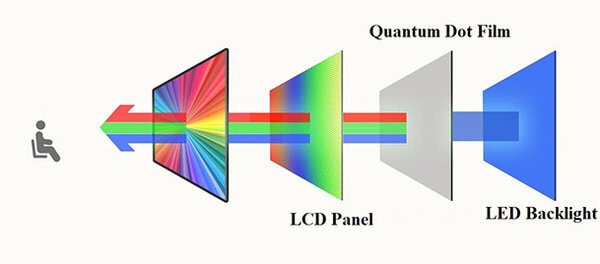
It doesn’t improve contrast as Mini LED does, but QLED TVs shine in brightness and vibrant visuals—often reaching over 1,500 nits and covering nearly 100% of the DCI-P3 color gamut. That makes them great for bright rooms and vivid video content.
Similarities Between Mini LED and QLED
While Mini LED and QLED enhance visual quality in different ways, they share several similarities:
- Both are LCD-based technologies, meaning they need a backlight to illuminate the screen.
- Both improve upon standard LED displaysby improving brightness, color, and image clarity.
- Both are often used together.For example, Samsung’s Neo QLED series combines Mini LED backlighting with QLED color layers, offering high brightness and precision in one display.
If you see a TV labeled “Mini LED QLED,” it means you’re getting the best of both technologies—quantum color and precise lighting control.
Differences Between Mini LED and QLED
In simple terms: Mini LED is about better contrast and deeper blacks, while QLED focuses on higher brightness and more vibrant colors.
If you remember just one thing: Mini LED improves how light is controlled, while QLED improves how color is displayed.
While both technologies enhance traditional LCD displays, they do so in fundamentally different ways. Let’s break down the key differences in real-world performance:
Backlight Technology
- Mini LED uses thousands of microscopic LEDs for backlighting.These smaller LEDs allow for precise local dimming, meaning the screen can darken or brighten specific areas more accurately.
- QLED, on the other hand, still uses standard LED backlighting.It enhances visuals by adding a quantum dot film to improve color, not contrast or dimming.
Contrast and Black Levels
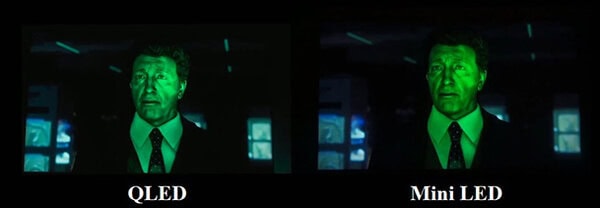
- Thanks to its advanced local dimming zones, Mini LED can achieve deeper blacks and higher contrast ratios.It reduces the “halo” or blooming effect around bright objects.
- QLED struggles with true black levels since it relies on fewer dimming zones or edge lighting. Blacks can look more like dark grays, especially in dark rooms. In real viewing conditions, this often results in less precise shadow detail and visible light bleed in dark scenes.
Brightness and Color Accuracy
- QLED displays are known for exceptional brightness and vibrant colors, making them ideal for use in well-lit environments. This makes QLED particularly effective for daytime viewing or spaces with strong ambient lighting.
- Mini LED also delivers high brightness, but its main strength lies in balancing brightness with contrast, offering a more natural image with deeper depth.
Viewing Angles
- Both technologies still use LCD panels, so viewing angles are average compared to OLED. However, Mini LED may perform slightly better depending on panel quality.
- Some high-end QLED TVs use IPS or VA panels with wide-angle enhancements, but neither tech matches OLED in this area.
Price and Availability
- Mini LED displays are generally more expensive, as the tech is newer and uses more complex manufacturing.
- QLED TVs and monitors are more affordable and widely available, especially from brands like Samsung, TCL, and Hisense.
Comparison Table Summary
| Feature | Mini LED | QLED |
| Backlight | Thousands of tiny LEDs | Standard LED with quantum dots |
| Contrast & Blacks | Excellent, deep blacks | Good, but not as deep |
| Brightness | High | Very high |
| Color Performance | Accurate, balanced colors | Vibrant, saturated colors |
| Viewing Angles | Moderate | Moderate to good (depending on panel) |
| Price Range | Premium | Mid-range to high-end |
| Best For | HDR, dark rooms, high-end gaming | Bright rooms, vivid visuals, general use |
Pros and Cons of Mini LED vs QLED
Mini LED Pros
- Outstanding black levels and contrast thanks to advanced dimming.
- Reduced halo effects during HDR content.
- Less risk of burn-in compared to OLED.
- Suitable for HDR video production, gaming, and home cinema—especially for users who want high contrast without the long-term burn-in concerns of OLED.
Mini LED Cons
- Typically more expensive due to newer tech.
- Still uses LCD, not self-emissive pixels like OLED.
QLED Pros
- Extremely bright, vibrant images—great for daytime use.
- More affordable than Mini LED and OLED.
- Excellent performance in mixed lighting conditions.
QLED Cons
- Poorer black levels in dark rooms.
- May show blooming in high-contrast scenes.
- Color accuracy may drop off at wide viewing angles.
Which One Should You Choose? (Home, Office, or Commercial Use)
For Business Use
- Retail & Showrooms: QLED is often the better choice here, as its high brightness and vivid colors remain visible even under strong ambient light.
- Creative Work & Studios: Mini LED excels with deeper blacks and color precision, making it better for photography, film editing, or medical imaging.
- Presentations & Meeting Rooms: QLED’s brightness and price make it a cost-effective solution for most office setups.
For Personal Use
- Home Theater Lovers: Mini LED is the clear winner. Deep contrast and HDR accuracy deliver a cinema-like experience.
- Gamers: Mini LED offers faster response times and lower blooming, especially in AAA titles with dark scenes.
- Everyday Viewers: QLED remains an excellent choice, offering bright, colorful images at a reasonable price. It’s great for sports, news, and streaming in well-lit rooms.
Ultimately, your choice depends on your budget, content type, and viewing environment—but choosing the wrong one can lead to disappointing real-world performance. But both are significant upgrades over standard LED TVs.
Still unsure?
- Choose Mini LED if you want the best picture quality and often watch in dark environments
- Choose QLED if you prioritize brightness and watch mostly in well-lit rooms
Mini LED vs QLED vs OLED: Quick Comparison
If you’re comparing all three, OLED is still the benchmark for picture quality—but Mini LED is the closest LCD alternative.
If you’re torn between Mini LED, QLED, and OLED, here’s a clearer breakdown of how each technology works—and where each one shines:
| Feature | Mini LED | QLED | OLED |
| Technology Type | LCD with dense Mini LED backlight | LCD with quantum dot color filter | Self-emissive (each pixel lights up) |
| Black Levels | Excellent (better than QLED) | Good, but not true black | Perfect black (individual pixel control) |
| Contrast | High, close to OLED | Moderate to high | Infinite contrast |
| Brightness | Very high (up to 2,000+ nits) | Extremely high (1,500–2,000 nits) | Moderate (600–1,000 nits) |
| Color Quality | Accurate and vibrant | Extremely vivid and bright | Natural and highly accurate |
| Viewing Angles | Better than standard LCD | Decent to good | Excellent (no color washout) |
| Burn-in Risk | None | None | Possible with static content |
| Price Range | Premium | Mid-range to premium | Premium to ultra-premium |
| Use Case Fit | High-end gaming, HDR movies, pro work | Bright rooms, general entertainment | Cinephiles, design professionals |
In summary:
- Choose OLED for the best picture quality, especially in dark rooms and for movies.
- Pick Mini LED if you want OLED-like contrast and detail without the burn-in risk.
- Go for QLED if you want extreme brightness and color pop at a more accessible price.
Last updated: April 2026
Conclusion
When comparing Mini LED vs QLED, there is no one-size-fits-all answer—but there is a right choice for your specific situation.
– Mini LED is the better choice for contrast, HDR performance, and dark-room viewing
– QLED is the better choice for brightness, color vibrancy, and well-lit environments
In simple terms:
If you want a more cinematic, high-contrast experience, go with Mini LED.
If you want a bright, vivid, and cost-effective display, QLED is often the smarter option.
Final takeaway:
Mini LED controls light better. QLED enhances color better.
Still deciding? Contact our team and we’ll help you choose the right display solution based on your real application—not just specs on paper.
Here are some of the most common questions people ask when comparing Mini LED and QLED:
FAQs
1.Is Mini LED better than QLED?
Yes, in terms of contrast, black levels, and HDR precision. However, QLED may be brighter and more cost-effective. In recent models, the gap has widened as Mini LED TVs continue to increase their local dimming zone counts.
2.Can a TV use both Mini LED and QLED?
Absolutely. Samsung’s Neo QLED series combines the two technologies to offer the best of both worlds.
3.Is Mini LED good for gaming?
Yes. With low input lag, high contrast, and reduced blooming, Mini LED is excellent for immersive gaming setups.
4.Which lasts longer: Mini LED or QLED?
Both offer long lifespans—typically 30,000 to 50,000 hours. Since both are based on LCD panels, they’re very durable.
5.What’s the difference between Mini LED and Neo QLED?
Neo QLED is Samsung’s branding for QLED TVs with Mini LED backlighting. It blends quantum dots and Mini LED in one display.
Related Articles You May Like:
LCD, LED, Or OLED: Which is Best for You?
Mini LED Vs OLED: Which Is Better In 2024?
Mini LED vs Micro LED: What You Need to Know
What Are The Major Advantages Of Micro LED Screens?
What’s The Science Behind OLED’s Eye-Popping Color Accuracy?