
Introduction
OLED vs LCD is still a hot topic nowadays. Even with newer tech like MicroLED and QD-OLED making waves, OLED and LCD remain the go-to choices for everything from TVs and monitors to digital signage. So, which one should you pick? The answer depends on what you need—whether it’s better image quality, lower cost, or longer lifespan. In this guide, we’ll explain the differences between an OLED screen vs LCD screen, show you how they work, and help you figure out which one’s right for you.
How OLED and LCD Technologies Work
LCD: Liquid Crystal Display Basics
LCD, or Liquid Crystal Display, uses a backlight that shines through a layer of liquid crystals. These crystals don’t emit light on their own but instead block or allow light to pass through, forming images. Most LCDs today use LED backlights to improve brightness and reduce power usage.
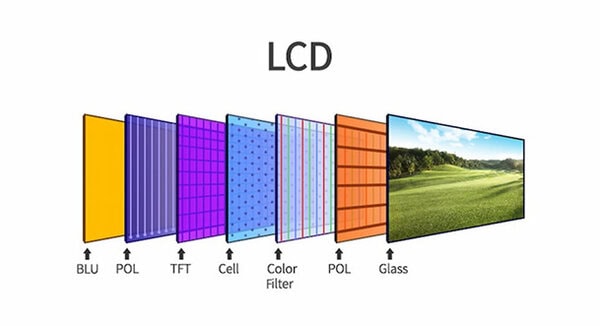
LCD technology has been around for decades and is commonly found in TVs, computer monitors, laptops, and smartphones. It’s cost-effective, reliable, and available in a wide range of sizes.
Quick LCD facts:
- Brightness: Up to 2,000 nits(ideal for bright environments)
- Lifespan: Around 50,000–100,000 hours
- Cost: Often 30–50% cheaperthan OLED at the same size
OLED: Organic Light Emitting Diodes Explained
OLED stands for Organic Light Emitting Diode. Each pixel in an OLED display emits its own light, which means it can turn on and off individually. As a result, OLED screens can produce perfect blacks and extremely high contrast ratios.
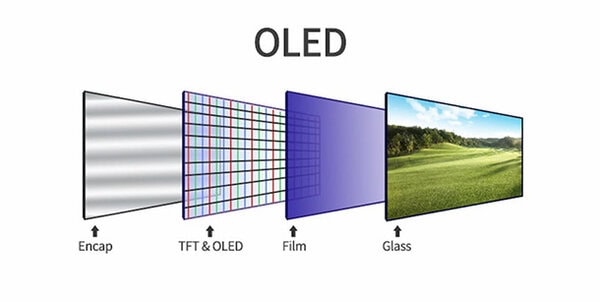
Because there is no need for a backlight, OLED panels are thinner, more flexible, and more energy-efficient in dark scenes.
Quick OLED facts:
- Contrast Ratio: Technically infinite(black = 0 nits)
- Response Time: As low as 1ms(great for gaming)
- Energy Use: More efficient in dark scenes, less so in bright ones
OLED vs LCD: Full Comparison Table
| Feature | OLED Screen | LCD Screen |
| Light Source | Self-emitting pixels | LED backlight |
| Contrast Ratio | Extremely high (infinite) | Moderate (~1,000:1 to 5,000:1) |
| Black Levels | Perfect blacks (pixel turns off completely) | Washed-out blacks (light always present) |
| Brightness | Moderate (600–1,000 nits) | High (up to 2,000+ nits with Mini-LED) |
| Viewing Angles | Excellent (up to 178°) | Decent to poor, varies by panel type |
| Screen Thickness | Very thin (as little as 2–4 mm) | Thicker due to backlight layer |
| Burn-in Risk | Yes, with static content over time | None |
| Lifespan | ~30,000 to 50,000 hours | ~50,000 to 100,000 hours |
| Cost | High | More budget-friendly |
| Use in Signage | Not recommended for static 24/7 use | Ideal for long-use, bright signage |
Deep Dive: Pros and Cons of OLED vs LCD
OLED Pros & Cons
✔ Pros
- Perfect Blacks & Contrast Ratio: OLED pixels turn off individually, delivering true black—ideal for home theaters or night-time viewing.
- Fast Response Times: Great for gaming and fast-moving video content; often under 1ms.
- Slim & Flexible Designs: OLED panels can be ultra-thin or even curved/foldable, offering design flexibility.
✘ Cons
- Risk of Burn-In: Static content (like logos on digital signage) may cause ghosting over time.
- Lower Peak Brightness: Struggles in very bright environments or direct sunlight.
- Higher Cost: OLED panels cost 20–50% morethan LCD in similar sizes.

LCD Pros & Cons
✔ Pros
- High Brightness: Better performance in brightly lit rooms or outdoor setups—some commercial LCDs exceed 1,500 nits.
- No Burn-In Issues: Great for displays showing fixed layouts like menus, dashboards, or static signage.
- Affordable & Mature: Mass production means lower price per inch, especially for larger screens.
✘ Cons
- Weaker Blacks & Contrast: Backlighting causes “grayish”blacks—less ideal for cinematic visuals.
- Slower Response Times: Often around 5ms+, which may introduce blur in fast scenes.
- Narrower Viewing Angles: Especially on lower-end or TN-panel LCDs, where colors shift off-center.
OLED vs LCD: Which Is Better for You? (Use Case Guide)
For Home Theaters / Netflix / Movies
Best choice: OLED
If you enjoy watching movies in a dimly lit room or value cinematic image quality, OLED is the clear winner. With support for Dolby Vision, HDR10+, and near-perfect black levels, OLED offers an immersive visual experience that LCDs simply can’t match.
Imagine watching “Dune” or “The Batman” on an OLED screen—dark scenes look inky black, with crisp highlights and no light blooming around subtitles.
For Bright Rooms or Outdoor Use
Best choice: LCD
In rooms flooded with natural light or in semi-outdoor spaces like patios or cafes, LCD performs better. High-end Mini-LED TVs can hit 2,000+ nits, making them easily visible even in direct sunlight.
For Gamers
Best choice: Depends
OLED provides ultra-fast response (0.1ms) and virtually no ghosting. Gamers playing story-driven titles like “Cyberpunk 2077” or “Horizon Forbidden West” will love OLED visuals. However, for games with static HUD elements or competitive eSports with long sessions, LCDs offer safer, long-term use with similar refresh rates (120Hz–240Hz) at lower cost.
For Phones/Tablets
Best choice: OLED
OLED has become the standard in flagship smartphones like iPhone 15 Pro and Samsung Galaxy S24. The benefits? Rich colors, deeper blacks, always-on displays, and better battery life due to adaptive refresh and dark-mode efficiency.
For Work / Office Monitors
Best choice: LCD
Office work involves prolonged use of static windows, Excel sheets, or software dashboards. LCDs are safer and cheaper, with no risk of burn-in. They’re also available in ultrawide formats ideal for multitasking.
For Digital Signage or Displays
Best choice: LCD or LED display
Digital signage runs 24/7 and often displays fixed logos, menus, or schedules. This makes OLED screens risky due to permanent burn-in. Commercial-grade LED displays, like those from YUCHIP, offer even greater brightness, modular sizes, and extreme durability—ideal for airports, shopping malls, and sports arenas.
Market Trends 2025: OLED vs LCD Who’s Winning?
In 2025, OLED has gained dominance in high-end consumer devices. Over 75% of premium smartphones and 40% of 55″+ TVs use OLED panels. Apple, LG, and Samsung continue investing heavily in OLED R&D.
However, LCD still leads globally in market share, thanks to lower prices and wide commercial usage. IDC reports that LCD screens make up nearly 65% of global display shipments—mainly in monitors, mid-range TVs, and signage.
Meanwhile, LED displays are disrupting the large-format display market. With customizable sizing, pixel pitches under 1.5mm, and brightness above 5,000 nits, they’re becoming the top choice for digital signage and events.
Final Thought: Which Display Should You Choose?
In conclusion, the OLED vs LCD decision depends on your usage scenario:
- Go with OLEDfor stunning visuals, perfect blacks, and home entertainment.
- Pick LCDfor bright spaces, static content, or tight budgets.
- Choose LED displaysfor large-scale, high-impact commercial applications.
Need a reliable LED screen solution for your next project? At YUCHIP, we design and deliver custom LED displays for stadiums, billboards, exhibitions, and retail. Contact us now for a free consultation and quote.
FAQs
1.What’s the difference between OLED and LCD?
OLED has self-lit pixels for better contrast and flexibility, while LCD needs a backlight. OLED offers superior image quality; LCD excels in brightness and durability.
2.Is OLED better than LCD?
In image quality, yes. OLED delivers richer blacks and colors. But LCD is brighter, longer-lasting, and cheaper—ideal for bright rooms or 24/7 signage.
3.Can OLED screens burn in?
Yes. Displaying static content for long periods—like menus or news tickers—can cause ghost images. Newer OLEDs have burn-in reduction features, but risk still exists.
4.Which lasts longer—OLED or LCD?
LCD generally lasts longer, especially in commercial environments. OLED’s organic materials degrade faster with heavy use or high brightness.
5.Is OLED worth the extra cost?
For movie lovers or creatives, absolutely. But if you’re cost-sensitive or need a display for business use, LCD or LED may be the smarter investment.
Related Articles You May Like:
Mini LED Vs OLED: Which Is Better In 2024?
Differences Between LED Display and LCD Display
LCD vs LED vs OLED | LED vs LCD TV | LCD vs LED Display
What’s The Science Behind OLED’s Eye-Popping Color Accuracy?